
The data job market in 2026 is booming. The US Bureau of Labor Statistics projects 36% growth for data scientist roles through 2033, the global analytics market is expected to reach $104 billion by the end of 2026, and nearly every mid-to-large company is actively hiring across data functions.
But "getting into data" is not one decision. It is at least three. The data analyst, the data scientist, and the analytics engineer occupy distinct positions in the modern data team, each with different responsibilities, tools, salary ranges, and career trajectories. Choosing between them is not just about which pays more. It is about how you want to spend your working days, what kind of problems you want to solve, and where you see yourself in five years.
Most comparison articles focus on the analyst and the scientist, overlooking the analytics engineer entirely. That is a mistake. The analytics engineer role is growing at roughly 40% year over year, and it fills a critical gap in how modern organisations turn raw data into reliable, governed, analysis-ready datasets. If you are exploring the modern data career map, all three roles deserve your attention.
What You Will Learn
· What each role actually does day to day, not just a list of skills
· How salary, growth, and demand compare across all three roles in 2026
· What these roles look like specifically in financial services and banking
· Which role is best suited to your interests, background, and goals
· How AI tools are reshaping each position and which skills remain essential
The Data Analyst: Turning Data into Decisions
The data analyst is the most accessible entry point into the data profession and, for many organisations, the most immediately valuable. Analysts translate data into insight that informs human decisions. They build dashboards, write SQL queries, produce reports, and help stakeholders understand what happened, why it happened, and what might happen next.
What Your Week Looks Like
A typical week as a data analyst might include: pulling sales or transaction data using SQL to answer a question from the product team, building a dashboard in Tableau or Power BI to track a key metric, meeting with stakeholders to understand what they need from the data, cleaning and validating a messy dataset before analysis, and presenting findings to leadership in a format that drives action.
Core Tools and Skills
SQL is the foundation. Every data analyst lives in SQL, and if you are considering this path, learning SQL is the single most important investment you can make. Beyond that, analysts typically work with Excel (still essential for ad-hoc analysis and quick modelling), a visualisation tool like Tableau or Power BI, and increasingly Python or R for deeper statistical work. Understanding what data actually is and how it flows through organisations provides the conceptual foundation.
In Financial Services
In a bank or insurer, data analysts often work in regulatory reporting, portfolio analysis, customer segmentation, or operational risk. They pull data from core banking systems, validate it against regulatory requirements, and produce reports for internal stakeholders and external regulators. Domain knowledge of products like credit cards, mortgages, and loans is often valued as highly as technical skill.
Salary and Growth
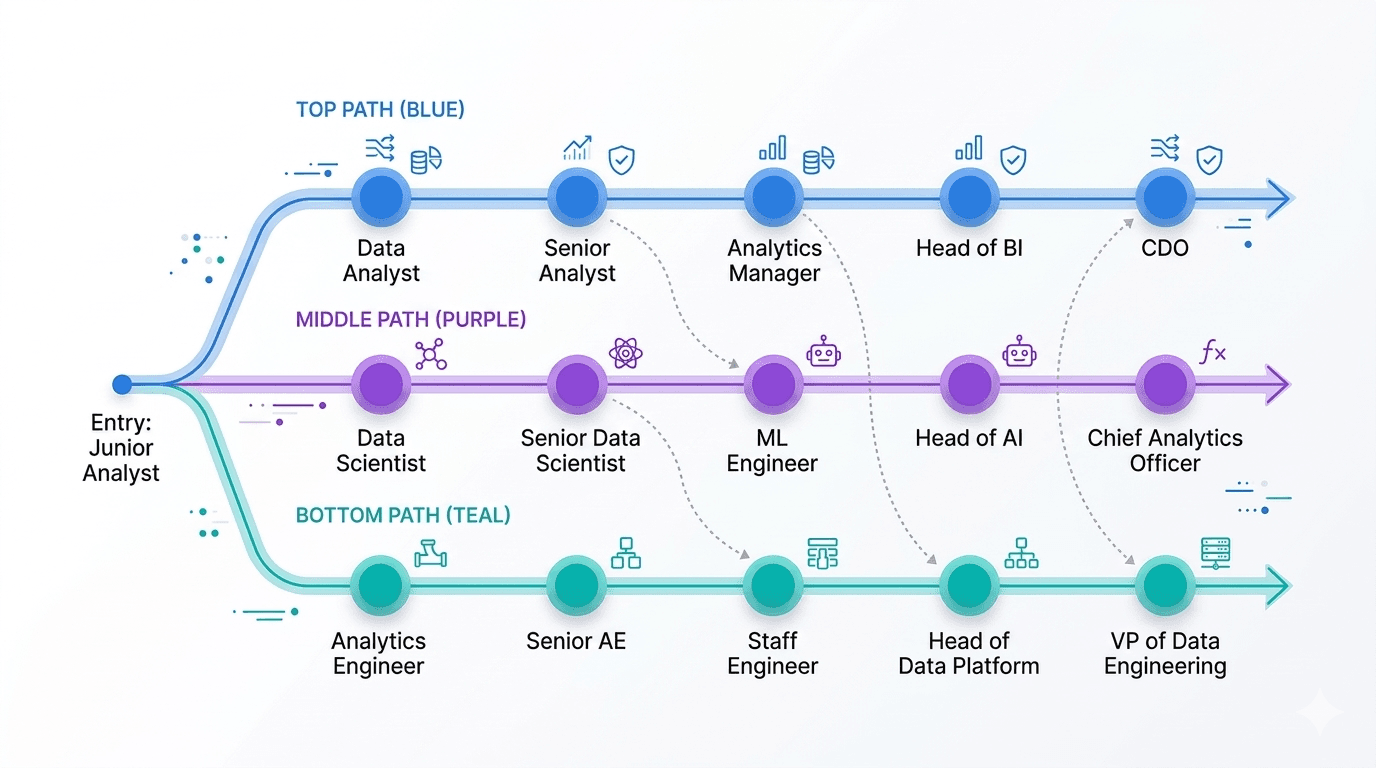
In the US, data analysts earn between $71,000 and $121,000 annually depending on experience, location, and sector. Entry-level roles start around $68,000 to $81,000. In the UK and Europe, equivalent roles range from GBP 30,000 to GBP 55,000 for mid-level positions. Growth paths lead to senior analyst, analytics manager, and eventually Chief Data Officer (CDO) or head of business intelligence.
The Data Scientist: Building Models That Predict and Automate
If the data analyst explains what happened, the data scientist predicts what will happen next and builds systems that act on those predictions. Data scientists work with machine learning, statistical modelling, and increasingly deep learning to solve problems that cannot be addressed with dashboards and reports alone.
What Your Week Looks Like
A data scientist might spend their week: exploring a new dataset to identify features that predict customer churn, training and evaluating a gradient-boosted model against a baseline logistic regression, writing Python code to clean, transform, and engineer features from raw data, collaborating with the engineering team to deploy a fraud detection model into production, and presenting model performance and business impact to leadership.
Core Tools and Skills
Python is the primary language (pandas, scikit-learn, TensorFlow, PyTorch). SQL remains important for data extraction. Jupyter notebooks are standard for experimentation. A strong foundation in statistics and probability is non-negotiable. Understanding how machine learning and analytics are shaping industries like finance helps data scientists connect their technical work to real-world outcomes.
In Financial Services
Data scientists in banking build credit scoring models, fraud detection engines, anti-money laundering (AML) classifiers, and customer lifetime value predictions. In this context, explainability is not optional. Regulatory frameworks like Basel III and the EU AI Act require that models used in credit decisions be transparent and auditable, which shapes the tools and methods data scientists in finance can use.
Salary and Growth
US data scientists earn between $130,000 and $175,000 at mid-level, with senior roles in major cities exceeding $200,000. The role typically requires a master's degree or equivalent experience, though many successful data scientists enter through the analyst route and build their skills over time. Career paths lead to senior data scientist, ML engineer, head of AI, or chief analytics officer.
The Analytics Engineer: The Bridge Role Modern Teams Need
The analytics engineer is the newest of the three roles, and the one most often missing from career guides. As IBM describes it, the analytics engineer "brings together data sources in a way that makes it possible to drive consolidated insights, building systems that can model data in a clean, clear way repeatedly." In practice, the analytics engineer sits between data engineering and data analysis, ensuring that the data warehouse is structured, documented, tested, and ready for analysts and scientists to use.
What Your Week Looks Like
An analytics engineer might spend their week: writing dbt (data build tool) models that transform raw data into clean, tested, documented tables in Snowflake or BigQuery, reviewing pull requests from other analytics engineers to ensure code quality and data model consistency, building and maintaining a semantic layer that defines how key business metrics are calculated, debugging a data quality issue that caused a dashboard to show incorrect revenue figures, and writing documentation so that analysts can self-serve without needing to ask engineering for help.
Core Tools and Skills
SQL is the primary language, but unlike the analyst, the analytics engineer writes SQL as code: version-controlled, tested, and deployed through CI/CD pipelines. dbt (data build tool) is the defining tool of the role. Cloud data warehouses (Snowflake, BigQuery, Databricks) are the primary environment. Git, YAML, and basic Python round out the stack. The role demands software engineering discipline applied to data transformation.
In Financial Services
In a bank or fintech, analytics engineers build the data models that feed regulatory reports, risk dashboards, and customer analytics. They define how "net revenue," "default rate," or "customer acquisition cost" is calculated, ensuring consistency across every report and model. As financial institutions face increasing pressure from regulations like DORA and the EU AI Act to document and audit their data pipelines, the analytics engineer's emphasis on testing, documentation, and governance becomes essential.
Salary and Growth
Analytics engineers earn between $122,000 and $155,000 in the US, positioning the role between the analyst and the scientist in compensation. The career path leads to senior analytics engineer, staff engineer, head of data platform, or director of data engineering. It is a strong choice for people who love SQL and data modelling but want more engineering rigour than a typical analyst role.
How the Three Roles Compare
Here is a practical way to think about the differences:
· The data analyst asks: "What happened and why?"
· The data scientist asks: "What will happen next, and can we automate the response?"
· The analytics engineer asks: "Is the data clean, tested, documented, and ready for both of them?"
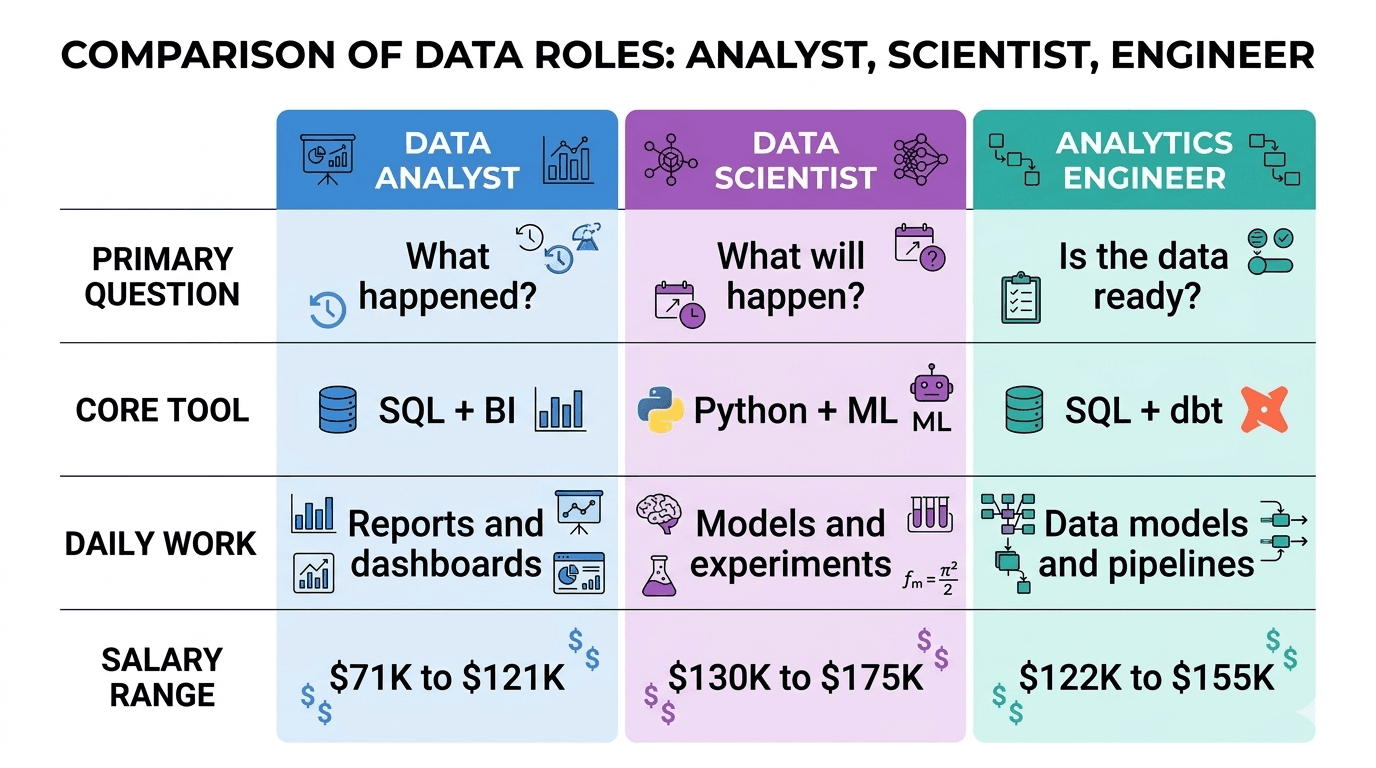
All three roles require SQL. All three benefit from Python. But the depth, direction, and daily experience of the work are different. The analyst works closest to business stakeholders. The scientist works closest to mathematical models. The engineer works closest to data infrastructure.
In financial services, where 59% of data science and analytics job demand is concentrated, all three roles are in high demand. But the expectation of domain knowledge (credit products, regulatory frameworks, risk terminology) adds a layer that generic data roles in tech companies may not require. If you are building a career in finance, start investing in domain knowledge early. Our guide to foundational tools for data careers maps the technical starting points, while the data ecosystem overview provides the broader context.
How AI Is Reshaping All Three Roles
According to dbt Labs' 2025 State of Analytics Engineering report, 80% of data practitioners now use AI in some part of their workflow. Copilot-style tools write SQL queries, automated EDA (exploratory data analysis) tools generate initial insights, and LLM-powered assistants help debug code and explain complex transformations.
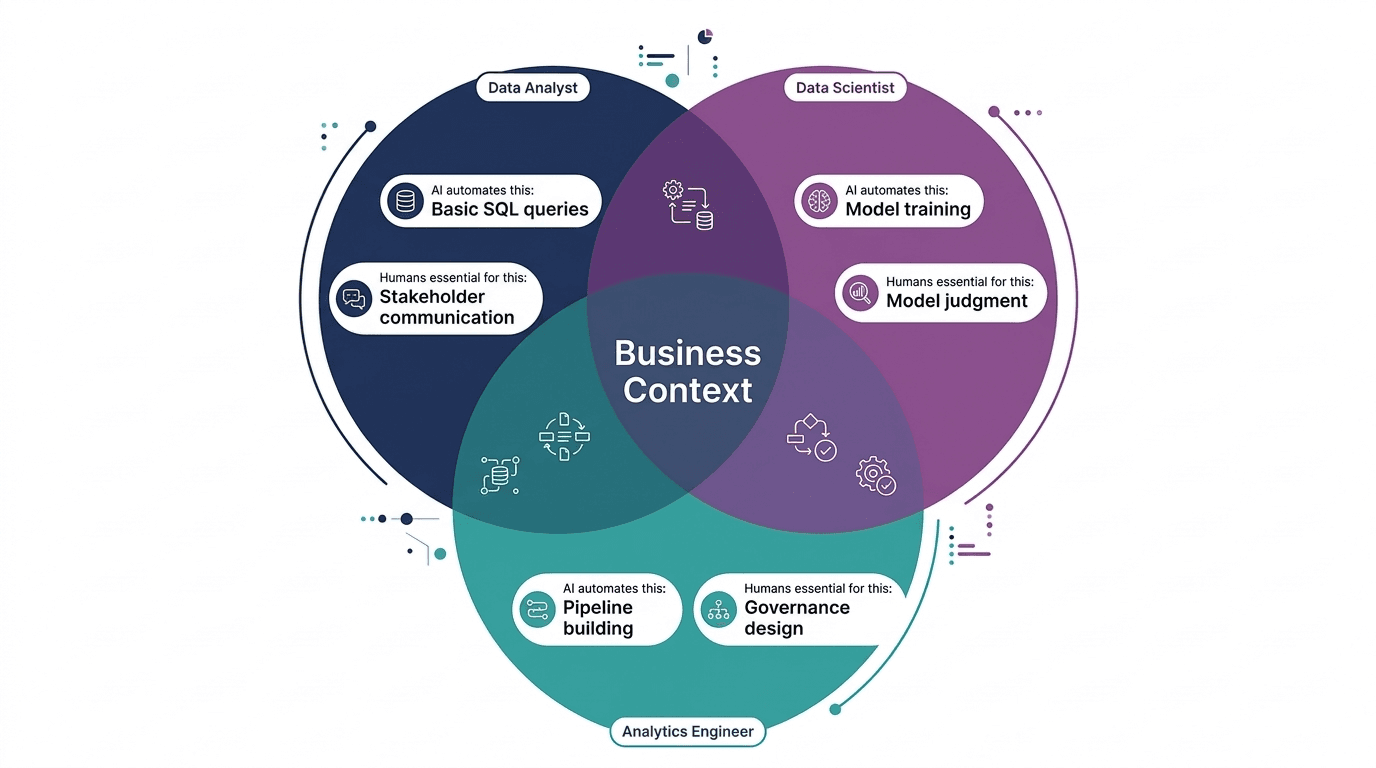
This does not mean these roles are being automated away. It means the baseline is shifting. Analysts who only write basic SQL queries will be less differentiated. Scientists who only train models without understanding business context will be replaced by AutoML tools. Engineers who only build pipelines without governance and testing discipline will lose ground.
The skills that remain essential are the ones AI cannot replicate well: understanding the business question behind the data request, exercising judgment about which model is appropriate for a given context, designing data models that reflect real-world business logic, communicating findings in a way that drives action, and navigating regulatory requirements that demand human accountability. These human skills are what separate a competent data professional from a truly valuable one.
Which Role Fits You?
Start with your interests, not with salary tables.
· If you enjoy explaining data to people who are not technical, finding patterns in numbers, and influencing decisions through clear communication, start as a data analyst.
· If you are drawn to mathematics, building predictive models, and solving problems that require creative experimentation, pursue data science.
· If you love SQL, care deeply about data quality and documentation, and want to apply software engineering practices to the data layer, the analytics engineer path is for you.
And if you are not sure? The data analyst role is the most accessible starting point. Many successful data scientists and analytics engineers began as analysts, built their business context over one to two years, and then specialised. There is no wrong door, only a first step.
Conclusion: Three Roles, One Data Team
The data analyst, the data scientist, and the analytics engineer are not competing roles. They are complementary functions within a well-structured data team. Understanding what each one does, what it pays, and where it leads is the first step toward making a deliberate career choice rather than drifting into whatever role happens to be available.
If you are just beginning your journey, start by building the foundational tools that all three roles share: SQL, basic Python, and an understanding of how data-driven decisions work in practice. From there, the path you choose should reflect how you want to spend your days, not just how much you want to earn.
In upcoming posts, we will dive deeper into the specific tools and skills that each role requires. Stay tuned.
Continue Reading
· Foundational Tools for Data-Related Careers
· What Is Data? A Complete Beginner's Guide for the Curious Mind