You might be wondering how I can become a data analyst. Or, how can I become a data engineer?
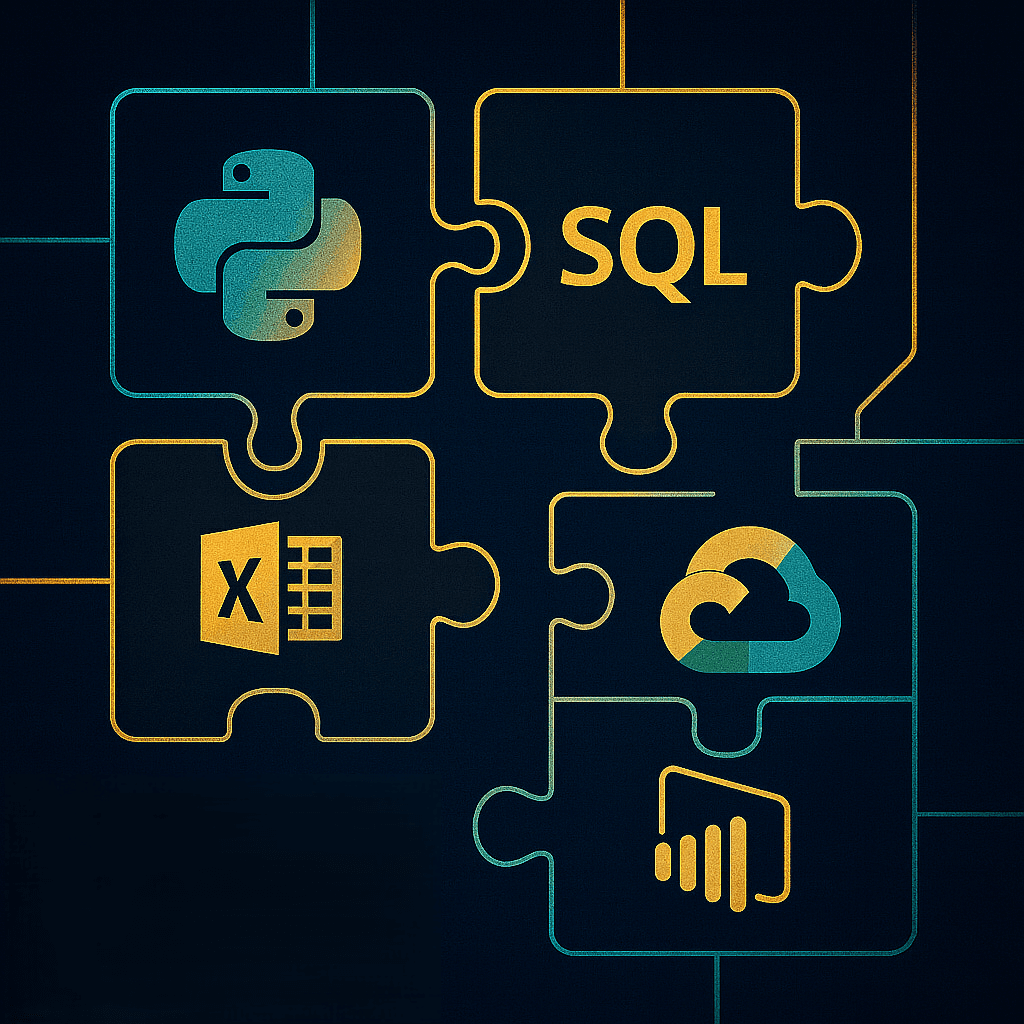
Before you may specialise as an analyst, engineer, or data scientist, you must first establish a solid foundation of tools, which serve as a common language for data professionals. The table below summarises the core technologies that underpin current data work, including spreadsheets, SQL, cloud platforms, and orchestration tools. Each appears somewhere in the data pipeline, from data collection to storage to analysis and visualisation.
These are more than just program names; they serve as the foundation for decision-making in the digital economy.
| Tool | Description | Main Use Cases |
| Excel / Google Sheets | Spreadsheet programs (Microsoft Excel and Google Sheets) used to organize, calculate, and visualize data in tabular form. | Quick data analysis, financial modeling, reporting, lightweight databases, collaboration, dashboards. |
| SQL | Structured Query Language used to manage, query, and manipulate relational databases. | Data extraction, filtering, aggregation, joins, KPI generation, ETL processes, database management. |
| Python | General-purpose programming language widely used for analytics, automation, and machine learning. | Data cleaning, analysis, scripting, modeling, automation, API integration, and workflow orchestration. |
| Power BI / Tableau | Leading business intelligence platforms for interactive dashboards and data visualization. | Visual storytelling, KPI dashboards, executive reporting, self-service analytics. |
| Snowflake / BigQuery / Amazon Redshift | Cloud-based data warehouses that provide scalable storage and fast querying for large datasets. | Data warehousing, analytics, large-scale reporting, model training data preparation. |
| AWS / Microsoft Azure / Google Cloud Platform | Major cloud computing platforms offering storage, compute, analytics, and AI services. | Cloud-based data pipelines, machine learning deployment, scalable infrastructure, data security management. |
| MySQL / PostgreSQL / MongoDB | Popular database systems — MySQL and PostgreSQL for structured (SQL) data, MongoDB for flexible NoSQL document storage. | Backend storage, transactional data management, analytics staging, and semi-structured data handling. |
| Airflow | Open-source workflow orchestration tool that schedules and automates complex data pipelines. | ETL automation, data pipeline management, dependency tracking, data quality workflows. |
| GitHub / GitLab | Version control and collaboration platforms built around Git for managing code and projects. | Version control, collaboration, code review, CI/CD pipelines, project documentation. |
| VS Code | Lightweight code editor by Microsoft with extensions for multiple programming languages and frameworks. | Coding, debugging, data engineering workflows, automation scripting, environment customization. |
| Power Query | Microsoft’s data connection and transformation engine integrated in Excel and Power BI. | Data cleaning, merging, filtering, and reshaping for analysis or visualization. |
| SAS | Enterprise-grade analytics and statistical software suite for data analysis, risk modeling, and reporting. | Credit-risk analysis, regulatory reporting, predictive modeling, statistical research, enterprise analytics. |
1. Excel and Google Sheets — The Gateway to Data Thinking
Almost all data professionals start here. The spreadsheet is where the current data work tale begins. Excel, and later Google Sheets, were the first digital tools that allowed anyone to organise, calculate, and visualise data without requiring technical knowledge. They remain effective for quick analysis, ad hoc reporting, and dashboards, particularly when clarity is more important than complexity.
Used by: Data Analysts, Business Analysts, Financial Analysts, Risk Analysts, and anyone starting in data-driven roles.
Check out our Beginner’s Guide to Learning Excel for Free!
2. SQL — The Universal Language of Data
SQL (Structured Query Language), which was developed in the 1970s, revolutionised how we interact with databases by giving a straightforward way to obtain specific data. It is the foundation of almost any data system, allowing teams to extract, connect, and summarise enormous datasets. Mastering SQL converts raw storage into insight, marking the first significant step from spreadsheets to scalable analytics.
Used by: Data Analysts, Data Engineers, BI Developers, Database Administrators.
Check out our Beginner’s Guide to Learning SQL for Free!
3. Python — The Engine of Modern Data Work
Python, which was created in the 1990s as a general-purpose language with a focus on readability, has grown to become the most versatile tool in data research. Its ease of use and diverse ecology make it suited for a wide range of applications, including data cleaning and machine learning. Today, Python is the language that combines analysis, engineering, and artificial intelligence into a single process. Its biggest strength is its open-source community and enormous ecosystem of libraries, which are produced and maintained by millions of people around the world. These libraries (for analysis, visualisation, and machine learning) make Python approachable for beginners but also strong for experts.
Used by: Data Analysts, Data Scientists, Machine Learning Engineers, Data Engineers, Automation Specialists.
4. Power BI and Tableau — From Numbers to Narratives
Power BI (Microsoft) and Tableau (originally from Stanford research) were created in response to the rise of self-service analytics and enable users to transform data into interactive graphics. These tools aid in the transformation of complex metrics into dashboards and visual narrative that are understandable to everyone, not just analysts. They close the gap between numbers and decisions, making data truly actionable.
Used by: BI Developers, Data Analysts, Business Intelligence Managers.
5. Snowflake, BigQuery, and Amazon Redshift — Where Enterprise Data Lives
As data volumes increased, traditional databases struggled to keep up.Cloud-based warehouses such as Snowflake, Google BigQuery, and Amazon Redshift have evolved to efficiently store and process enormous datasets.They isolate storage from computational power, allowing organisations to immediately grow and evaluate millions of records without performance concerns.
Used by: Data Engineers, Data Architects, Analytics Engineers, BI Developers.
6. AWS, Microsoft Azure, and Google Cloud Platform — The Cloud Backbone
Cloud computing has transformed how data systems are built and maintained.Platforms like as AWS, Azure, and GCP provide global infrastructure for storage, analytics, APIs, and machine learning.They let businesses to innovate more quickly and securely, freeing teams from the burden of managing physical servers.Understanding cloud platforms is becoming a universal necessity for modern data workers.
Used by: Data Engineers, Cloud Architects, ML Engineers, DevOps Specialists.
7. MySQL, PostgreSQL, and MongoDB — The Databases Behind Every App
Databases are used by almost every digital service, including websites and mobile banking.MySQL and PostgreSQL dominate structured, relational storage, but MongoDB provides flexible, document-based organisation for unstructured data.Understanding how data travels across current apps requires knowing how these systems store and retrieve information.
Used by: Database Administrators, Backend Developers, Data Engineers, Application Developers
8. Airflow — The Conductor of Data Pipelines
Apache Airflow, developed at Airbnb in 2014, has since become the industry standard for orchestrating data operations.It ensures that extraction, transformation, and loading (ETL) procedures occur consistently and in the correct order.By automating pipelines, teams can transport data across systems without manual oversight, providing the foundation for scalable, repeatable analytics.
Used by: Data Engineers, Analytics Engineers, ML Engineers, DevOps Professionals.
9. GitHub and GitLab — Collaboration for the Data Era
As data projects developed in complexity, cooperation and version control became critical.GitHub and GitLab, based on Linus Torvalds' Git system, enable teams to track code changes, experiment safely, and document progress.These solutions make teamwork systematic, transparent, and auditable, which is essential for any multi-person data setting.
Used by: Data Scientists, Data Engineers, Analysts, Software Developers.
10. VS Code — The Everyday Workbench
Microsoft launched Visual Studio Code (VS Code) in 2015, and it soon became the preferred editor for both developers and data practitioners.It supports practically any data language, including Python, SQL, YAML, and Markdown, by combining speed, customisation, and sophisticated extensions.It's the environment where exploration, coding, and documentation come together.
Used by: Data Engineers, Data Scientists, Software Developers, Automation Specialists.
11. Power Query — Cleaning Made Simple
Microsoft introduced Power Query as a bridge between Excel and Power BI, which streamlines one of the most difficult tasks in analytics: data cleaning. Users can utilise its straightforward interface to mix, reshape, and alter data without having to write. It's an easily accessible solution that offers the power of ETL (Extract, Transform, Load) to non-technical people.
Used by: Data Analysts, BI Developers, Business Users managing regular reports.
12. SAS — The Classic Powerhouse
SAS (Statistical Analysis System), developed at North Carolina State University in the 1970s, became the industry standard for enterprise analytics even before the term "data science" was coined. It is trusted for large-scale statistical modelling, compliance reporting, and mission-critical assessments where governance and dependability are crucial. Though other tools are gaining traction, SAS remains deeply established in many industries that prioritise precision and auditability.
Used by: Data Scientists, Risk Analysts, Statistical Researchers, Enterprise Data Teams.
Closing Thought
These tools constitute the fundamental syntax of data work. Whether you're examining your first dataset or automating global processes, they're present in almost every workflow.
Learn them in stages, beginning with Excel and SQL, progressing to Python and business intelligence tools, and finally to cloud and automation platforms. Mastering the foundations is not about memorising instructions; it is about learning to think in systems, where each tool contributes to the conversion of data into insight.