
On March 10, 2026, the Central Bank of Nigeria issued a directive that shifted the entire regulatory landscape for African banking. The CBN's Baseline Standards for Automated AML Solutions are not merely a recommendation to adopt AI: they are a mandate. And buried in those 12 standards and 100 requirements is a principle that separates regulatory leaders from laggards: explainability matters more than algorithm choice.
What You Will Learn
- The specific governance, explainability, and validation requirements CBN mandates for AI-driven AML systems
- How CBN standards align with (and diverge from) EBA guidelines, FATF recommendations, and the EU AI Act
- Real implementation barriers African banks face: data quality, talent gaps, legacy system integration, and total cost of ownership
- A 90-day action plan for risk and compliance teams across Nigeria, Kenya, and South Africa
- How early-mover banks with robust governance can differentiate from late-comers on regulatory and competitive fronts
What the CBN Just Required
On March 10, 2026, the CBN published Circular BSD/DIR/PUB/LAB/019/002, introducing 12 overarching standards with 100 specific requirements for automated AML solutions. The scope covers all regulated financial institutions: Deposit Money Banks (DMBs) face an 18-month compliance deadline (approximately September 2027), while fintechs, payment service providers, and mobile money operators have 24 months (March 2028).The framework mandates more than just "deploy AI." Key governance requirements include:Unified Customer View: Integrated KYC and KYB data across all channels.Enhanced Beneficiary Screening: Real-time screening against OFAC, UN, and national sanctions lists with entity risk scoring.Automated Transaction Monitoring: AI/ML systems detecting suspicious activity with configurable risk thresholds and human escalation.AI/ML Model Governance: Transparent model configuration, documented explainability mechanisms explaining why individual alerts trigger, independent annual validation of model performance and bias testing across protected characteristics.Risk-Based Customer Profiling: Dynamic customer risk scoring with continuous behavioral monitoring.Regulatory Reporting: Real-time alert generation and reporting to the CBN and Nigerian Financial Intelligence Unit (NFIU).
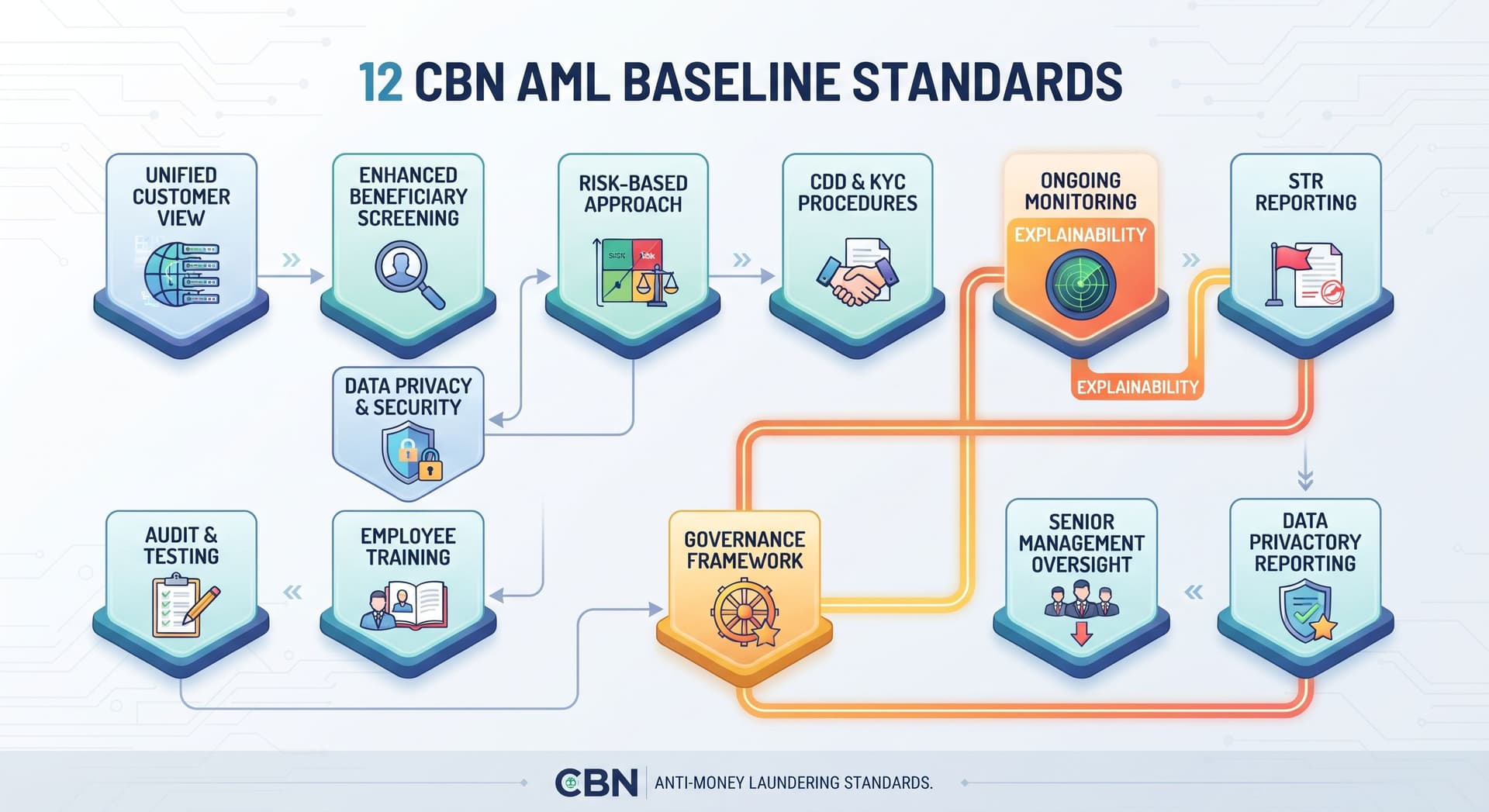
By June 10, 2026, all institutions must submit implementation roadmaps to the CBN Compliance Department. This is not aspirational guidance: it is regulatory requirement with compliance oversight. The CBN has already signaled that it will conduct compliance reviews and impose sanctions on institutions that miss the 18 and 24-month deadlines respectively.
Why This Is a Quiet Watershed
The CBN's announcement is a watershed moment for three reasons:First, it writes AI into AML as regulatory mandate, not vendor option. Prior to March 2026, African banks treated AI adoption as discretionary: a competitive advantage if they invested, but not a compliance requirement. The CBN changed that. Nigerian banks cannot now opt for "traditional" AML investigation alone; they must deploy AI and govern it transparently. This shift is irreversible and signals to the entire region that AI in compliance is the new baseline.Second, the CBN's explainability requirement is the first African central bank directive to explicitly demand transparency in financial crime AI. The requirement for "documented explainability mechanisms explaining why alerts are triggered" mirrors global best practice (FATF, EBA, Wolfsberg Group) but is significantly more prescriptive than precedent in the region. Banks can no longer operate black-box AML systems. This distinction is critical: explainability is not a "nice to have" for regulatory auditors; it is a hard requirement for CBN compliance.Third, the 18-month deadline for DMBs creates an immediate competitive cliff. Banks that move quickly to build robust governance and explainability frameworks will gain regulatory credibility and operational maturity. Late-comers will face compressed timelines, higher costs, and greater regulatory scrutiny. This is not a five-year transition; it is 18 months. The asymmetry of timing creates a strategic window for early movers.
What 'Automated AML Solutions' Actually Demands in Practice
In practice, meeting CBN baseline standards requires solving five interconnected technical and governance challenges:Data Governance and Quality: Historical AML data in most Nigerian banks reflects investigator bias, inconsistent decision-making, and legacy typologies. Standardizing and cleaning this data is resource-intensive. Many banks lack data lineage and feature engineering documentation. The CBN mandate for "independent annual validation of model performance" will expose this gap immediately. Data quality issues are not technical curiosities; they directly impact model fairness, regulatory risk, and the ability to demonstrate compliance.Model Development and Validation: Banks must establish independent third-party validation of model accuracy, fairness across customer cohorts, and performance monitoring for drift. This is not a "build once, run forever" operation; it requires continuous oversight. The CBN expects to see annual revalidation reports, bias testing results, and documented model performance across customer demographics. This adds significant operational cost.Explainability Mechanisms: The most technically demanding requirement. Banks must document and test how their AML models explain individual alerts to investigators and regulators. Explainability techniques include SHAP (SHapley Additive exPlanations), LIME (Local Interpretable Model-agnostic Explanations), and rule-based decision trees. Choosing the wrong approach wastes months and creates downstream compliance gaps.Human Oversight and Escalation: The CBN mandates documented escalation procedures. Alerts cannot simply flow from model to investigator; there must be governance structure, case review, and human sign-off. This requires compliance teams to redesign workflow and documentation. The human-in-the-loop requirement is intentional: it ensures that no suspicious activity is acted upon without human judgment.Documentation and Audit Trail: The CBN will expect to see model card, risk assessment, governance framework, testing protocol, and bias testing results. Many banks lack templates and processes for this documentation. Compliance teams will need to establish documentation standards and archive all model versions and validation reports for audit purposes.
How This Compares With EBA Guidelines and the EU AI Act
The CBN's approach aligns with global norms while diverging in speed and prescriptiveness.The EBA (European Banking Authority) and its successor, the Anti-Money Laundering Authority (AMLA, operational as of January 1, 2026), emphasize principles-based guidance: transparency, explainability, and risk management. However, AMLA's guidance is still in transition, and the EBA's August 2025 SupTech report acknowledges AI's role in reducing false positives without mandating specific governance steps. The EBA approach gives banks flexibility but less certainty.
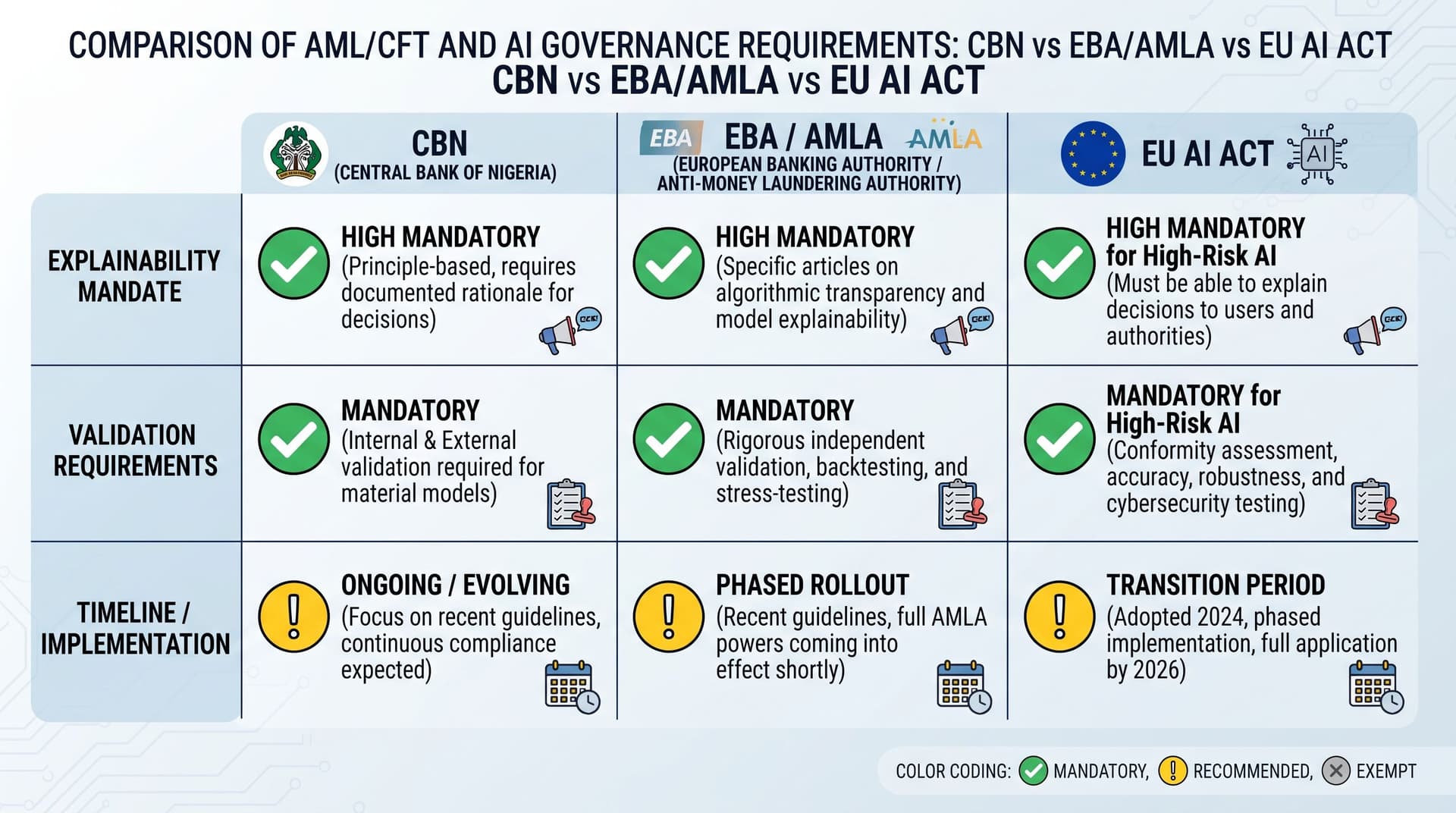
The EU AI Act (enforcement date August 2, 2026) classifies financial fraud detection systems as exempt from high-risk requirements, a critical carve-out for EU banks. This means they avoid some of the strictest AI governance rules. However, systems assessing individuals for AML/CFT compliance may face higher scrutiny. The CBN's approach is more prescriptive: it mandates explainability and annual validation regardless of model type. African banks cannot rely on exemptions; they must demonstrate governance.The FATF (Financial Action Task Force) 2021 publication, "Opportunities and Challenges of New Technologies for AML/CFT," endorsed AI as enabling "faster, cheaper, and more effective" compliance. The FATF recommends explainability but stops short of a mandate. The CBN goes further.For pan-African institutions, this creates a compliance puzzle: Nigerian banks must meet CBN explainability and validation requirements, Kenyan fintechs must navigate the Central Bank of Kenya's (CBK) emerging guidance (final stages as of April 2026), and South African entities must prepare for the SARB's joint AI governance framework (planned for July 2026). No single solution fits all three jurisdictions. Organizations operating across the continent must develop governance strategies that satisfy the most stringent regulator (Nigeria) while remaining adaptable to others.
Implementation Realities for Nigerian Banks and Pan-African Fintechs
The compliance clock is ticking, and most institutions are not ready.Talent Constraint: Few Nigerian banks have in-house AI/ML engineers capable of developing, validating, and governing AML models. Many have purchased vendor solutions without building internal capability to oversee them. This talent gap is acute and expensive: AI engineers in Lagos command salaries competitive with London. Building a team of three data scientists and explainability specialists will require recruitment from global markets or significant upskilling of existing staff.Cost Barrier: Compliance costs for a mid-tier bank are estimated at USD 500K to USD 5M, depending on institution size, data maturity, and approach (vendor vs. build). For smaller fintechs, this is prohibitive. Many will merge or cease operations rather than comply. The cost barrier creates a consolidation opportunity for larger, well-capitalized institutions.Vendor Landscape: Global vendors (NICE Actimize, SymphonyAI, Fiserv) dominate but come with steep licensing costs and long implementation timelines (6-12 months). Regional vendors (Smartcomply in Nigeria, ComplyAdvantage, Strise, Silent Eight) are emerging with cost and customization advantages, but many lack the independent validation and industry track record CBN auditors will scrutinize. Banks will face tough vendor evaluation decisions.Legacy System Integration: Many Nigerian banks still operate core banking systems that lack modern APIs. Integrating a new AML platform requires custom middleware and can take 12-18 months. For banks on the September 2027 deadline, this leaves only months for testing and remediation. Legacy system constraints are not technical inconveniences; they are hard blockers for timely compliance.Bias and Fairness: Historical AML data contains investigator bias. Banks must test for fairness across demographic cohorts (gender, age, geography) as the CBN requires. Few banks have conducted this analysis; most will discover they are over-alerting on certain customer segments, creating both compliance risk and reputational liability. Remediation requires retraining models and auditing decisions, further compressing timelines.
What Risk Teams Across Africa Should Do in the Next 90 Days
The CBN roadmap deadline is June 10, 2026. For risk teams in Nigeria, Kenya, and South Africa, the next 90 days should focus on three actions:Assessment and Gap Analysis: Audit your current AML systems against the 12 CBN standards. For each standard, identify what you have (vendor system, custom build, manual process), what is missing (explainability documentation, bias testing, independent validation), and what the gap costs in time and money. Document the answer to the CBN roadmap requirement: "Why can we not meet September 2027 deadline?" (This is honest and better than false confidence.) Be specific about data quality issues, talent constraints, and system integration challenges.
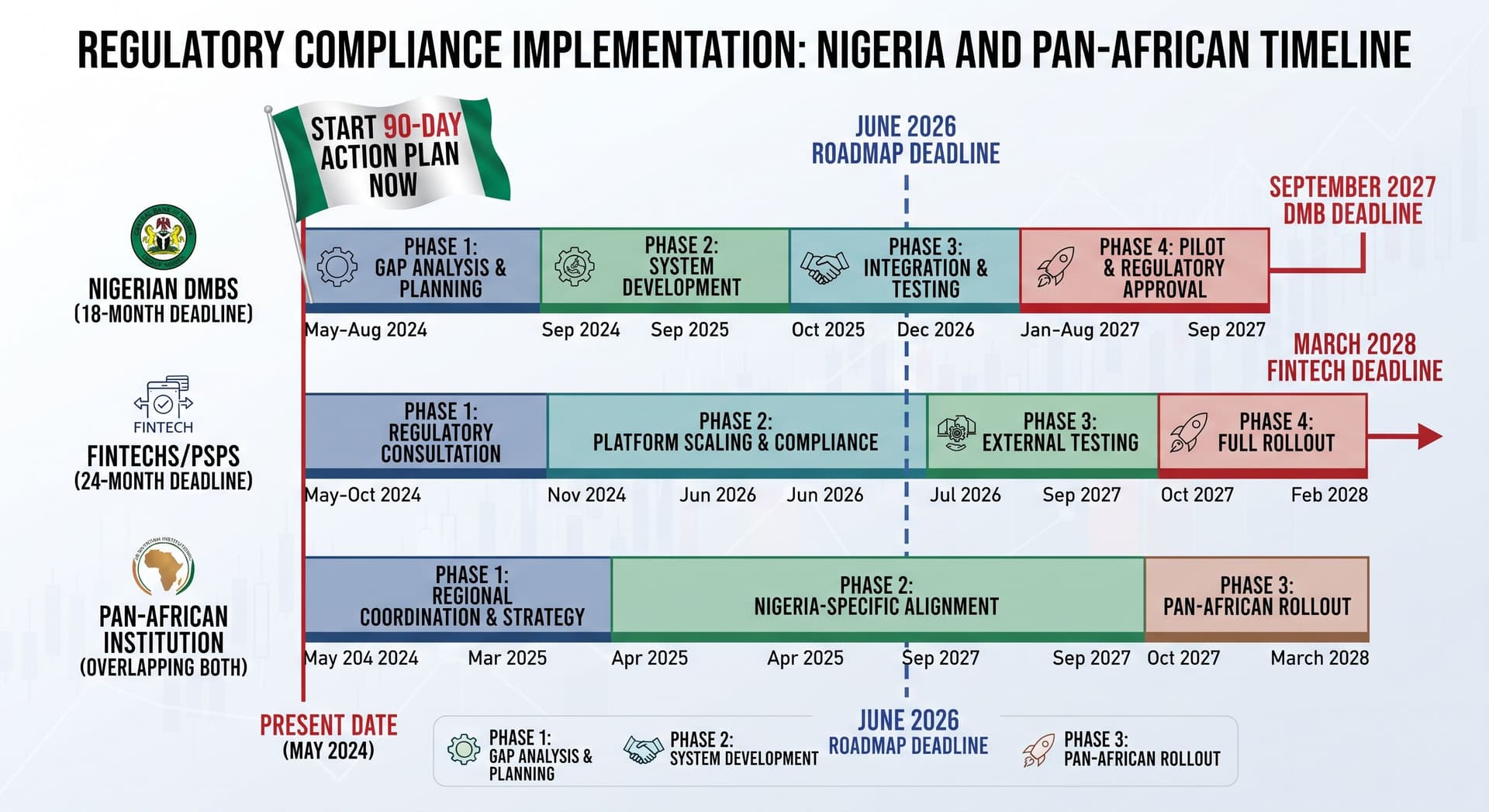
Talent Sourcing and Governance: Identify the three to five roles your team needs: AI/ML engineer, explainability specialist, model validator, and governance coordinator. You do not need to hire all immediately, but you need recruitment timelines. If you are buying from a vendor, you also need someone who understands your vendor's explainability approach and can validate it annually. Start recruitment discussions now; top talent is scarce and expensive.Strategic Vendor or Build Decision: Request demos and proposals from two to three vendors. Evaluate total cost of ownership, not just licensing. Ask each vendor to explain how their system meets the "independent annual validation" and "explainability mechanism" requirements. If you build in-house, budget for a three-person team over 18 months. Make this decision by June 2026; implementation cannot begin without clarity on vendor vs. build.For pan-African institutions: Start mapping out how a single AML solution will navigate Nigeria (CBN explainability mandate), Kenya (CBK principles-based guidance), and South Africa (SARB joint framework pending July 2026). This is a strategic multiplier problem: the team that solves for three jurisdictions simultaneously will differentiate operationally and competitively. Consider establishing a regional governance center to oversee compliance across jurisdictions.